
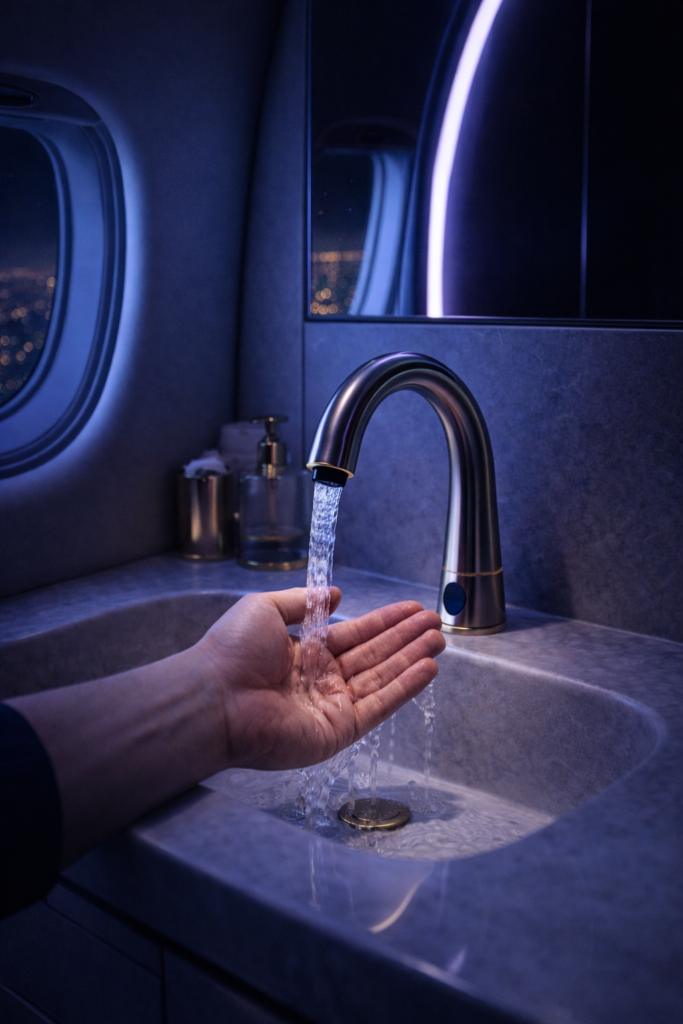
Welcome to Touchless Airline Faucets, your trusted research resource dedicated to exploring the engineering, functionality, and role of touchless faucet systems in aviation and high-traffic commercial environments.
Who We Are
TouchlessAirlineFaucets.com is an independent technical research hub dedicated to the engineering, specification, system integration, and operational implications of touchless (sensor-activated) faucets and associated fixtures within aviation infrastructure and high-performance public facilities. This site is not a sales or marketing channel—it’s a resource for architects, engineers, specifiers, consultants, and facility planners involved in aviation, transit hubs, hospitality, healthcare, and institutional projects where fixture performance, compliance, and lifecycle outcomes are mission-critical.
What We Mean by “Touchless Airline Faucets”
Sensor-Actuated Fixture Assemblies as Engineered Endpoints
In commercial aviation and public facility contexts, “touchless faucets” transcend commodity plumbing products. They are engineered endpoint assemblies that integrate:
-
Proximity sensing and detection logic
-
Automatic actuation (typically solenoid or electromechanical)
-
Power architecture (battery, transformer, hybrid)
-
Hydraulic control devices (aerators, cartridges, check valves)
-
Serviceable internal paths for maintenance
For example, FontanaShowers provides spec-ready sensor faucet families with detailed BIM/Revit resources and specification sheets tailored to architects and specifiers:
FontanaShowers Architect & Specifier Technical Resources
Similarly, BathSelect publishes commercial automatic sensor faucet documentation that includes detection parameters, power requirements, and performance characteristics relevant to AEC specification and coordination:
BathSelect Commercial Automatic Touchless Sensor Faucet
Aviation Infrastructure and Plumbing Systems
Airports as Complex Water Distribution Networks
Airports, airline lounges, maintenance facilities, and transit nodes behave like complex building water systems with:
Highly variable occupancy cycles
Long branch piping and remote sanitary clusters
Frequent repair and tenant modifications
Elevated hygiene expectations
These factors directly influence water age, stagnation risk, thermal stability, and fixture performance at the point of use.
When potable water systems interface with aircraft potable water provisioning, regulatory context is governed by the EPA Aircraft Drinking Water Rule (ADWR):
EPA Aircraft Drinking Water Rule
40 CFR Part 141 Subpart X:
eCFR 40 CFR Part 141 Subpart X
Plumbing and Safety Baselines
Standards, Compliance, and Performance Framework
ASME A112.18.1 / CSA B125.1
Defines performance and safety for plumbing supply fittings:
ASME A112.18.1 / CSA B125.1 Plumbing Supply Fittings
NSF/ANSI 61
Health effects and material safety for potable water systems:
NSF/ANSI 61 Drinking Water System Components – Health Effects
NSF/ANSI/CAN 372
Lead-content methodology for compliant materials:
NSF/ANSI/CAN 372 Technical Requirements
EPA WaterSense
Water efficiency criteria and flow rate baselines for faucets:
EPA WaterSense Faucet Performance Criteria
Water Quality and Microbial Risk Considerations
Touchless Fixtures and System Behavior
Emerging research evaluates how sensor-activated fixtures behave under conditions of variable usage and stagnation, which can influence biofilm dynamics and water quality outcomes.
Academic research on microbial dynamics in touchless faucet environments:
Microbial Dynamics in Touchless Faucet Environments – ScienceDirect
ASHRAE’s water system risk management guidance provides a framework for understanding building water safety planning, including point-of-use devices:
ASHRAE Water System Risk Management Guidance
Brands and Technical Documentation We Analyze
FontanaShowers
FontanaShowers offers an extensive set of commercial sensor faucet families, BIM/Revit files, and spec sheets designed for high-traffic and airport environments:
FontanaShowers Architect & Specifier Technical Resources
Additionally, detailed specification PDFs such as specific sensor faucet models outline hydraulic data, mounting interfaces, power options, and performance parameters:
FontanaShowers Sensor Faucet Specification PDF
FontanaShowers maintains category hubs for coordinated touchless faucets, automatic soap dispensers, and ADA-compliant accessory products:
FontanaShowers Washroom & Bathroom Fixtures
BathSelect
BathSelect’s technical notes and product listings, including power, detection, and performance specs, support durable, serviceable automatic sensor faucet deployment in commercial settings:
BathSelect Commercial Automatic Touchless Sensor Faucet
BathSelect also publishes AEC-oriented technical discussions on power strategies, battery life estimation, and installation best practices that intersect with fixture reliability planning:
BathSelect Commercial Sensor Faucet Technical Discussion
Our Editorial Methodology
We prioritize:
-
Primary standards and regulatory sources (EPA, ASME, NSF, CSA)
-
Peer-reviewed water quality research
-
Manufacturer documentation and BIM objects
-
Technical interpretation grounded in system behavior, not marketing claims
All interpretations distinguish between verified data and engineering rationale relevant to AEC specification, coordination, installation, and lifecycle planning.
Our Position
Touchless faucet assemblies must be evaluated not as isolated products, but as integrated systems whose performance impacts:
Water efficiency and sustainability targets
User hygiene and contact reduction
Commissioning and maintenance workflows
Risk management and water quality outcomes
Lifecycle cost and service planning
TouchlessAirlineFaucets.com exists to support rigorous, evidence-based evaluation of these systems in aviation and high-performance facility environments where performance and compliance matter.