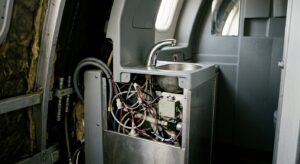
Metered dose on an aircraft lav faucet runs roughly 0.3 to 0.6 L per activation, not because the sensor or solenoid can’t deliver more, but because every liter on board has to be carried, heated, and serviced within a potable tank that typically holds 150 to 200 L on a narrow-body. The dose is a water-budget line item, sized against passenger count, flight-leg length, and the reliability of ground servicing at the next stop. Specify the faucet flow without that math and you either run tanks dry mid-flight or oversize a system that adds dead weight on every cycle.
Potable Tank Capacity By Aircraft Type
Tank sizing varies by airframe and galley/lav configuration, but narrow-body aircraft in domestic and short-haul service commonly carry in the 150 to 200 L range. Wide-bodies scale up with passenger count and lav fixture count, but the per-lav water allocation doesn’t scale linearly, since crew rest, galley potable draw, and lav handwashing all compete for the same tank. A specifier working a retrofit needs the actual tank capacity and lav count from the aircraft’s water system schematic, not an industry average, because the dose-per-cycle figure only makes sense against that specific budget.
The weight penalty of potable water is also non-trivial. A liter weighs a kilogram, and a 200 L tank filled to capacity is carrying roughly 200 kg before anyone has washed a hand. Airlines manage this by flying tanks partially filled on short legs with known passenger loads, which tightens the available-water margin further and makes metered dosing a hard constraint rather than a convenience feature.
Metered Dose Versus Flight-Leg Demand
A 0.3 to 0.6 L dose per activation is calibrated against expected lav visits per flight leg, not against what a user would draw from an unrestricted tap. On a full narrow-body with a single aft lav, that visit count can run into the hundreds over a long flight day with multiple legs and no servicing in between. Multiply dose volume by expected activations and you get the lav’s water draw for the rotation; multiply that by lav count and galley draw and you get whether the tank makes it to the next scheduled service point.
This is why dose volume isn’t set once and left alone. Airlines and MROs adjust metering based on route profile. A hub-to-hub short-haul aircraft serviced every turn can run a tighter margin than one flying longer rotations between fill-ups, and the faucet’s dose setting (where field-adjustable) gets tuned accordingly during entry-into-service or after a route reassignment.
- Short-haul, high-frequency turns: tighter dose tolerable since tank gets topped off almost every stop.
- Long-haul or remote-station rotations: dose and tank margin both need to cover multiple legs without guaranteed servicing.
- High-density single-aisle configurations: more passengers per lav means dose volume matters more, not less, since activation count per leg climbs.
Ground Cart Quality And Turnaround Risk
The tank only gets refilled to the dose calculation’s assumption if the ground cart delivers water that meets spec and the turnaround window allows a full service. Ground servicing carts and cabinets are expected to meet NSF/ANSI 61 for water quality in the fittings and components that contact potable water, which matters because a cart with a compromised seal or an out-of-spec hose can introduce contamination faster than any onboard filtration is designed to catch. A specifier evaluating a new station’s ground support equipment should ask for the cart’s NSF/ANSI 61 documentation before assuming the water budget math holds, because a contaminated top-off is a bigger operational problem than a low dose volume.
Turnaround risk compounds this. A 25-minute gate turn at a secondary station with one ground cart serving multiple aircraft doesn’t guarantee a full potable fill every time. If the cart runs short, crews either accept a partial fill and report reduced water state to the next crew, or dispatch delays the flight to top off. Neither outcome is something the faucet’s metering circuit can fix; it can only make a given tank volume last longer by capping dose size.
Cold-Climate Hubs And Line Freezing
Stations below freezing for extended ground time introduce a second constraint on top of volume: line integrity. Lav faucet supply lines and the tank itself need heat trace or insulation sufficient to prevent freeze-up during an overnight at a cold-soak gate, and that protection has to hold through towing, deicing, and extended power-off periods when cabin heat isn’t running. A faucet that doses correctly in a 70°F test lab can still fail at a Minneapolis or Calgary overnight stand if the feed line between tank and faucet isn’t adequately protected.
MRO specs for cold-climate hub operators typically call out minimum heat trace wattage per linear foot of exposed line and insulation R-value for the tank itself, separate from the faucet’s own spec sheet. When evaluating a faucet for a route network that includes northern-tier or high-altitude cold stations, confirm the OEM’s supply line protection requirements are compatible with the airframe’s existing heat trace routing, not just the faucet’s rated operating temperature range.
Specifying Flow Against The Water Budget
Dose volume, tank capacity, route profile, and servicing reliability are one system. Changing any one without checking the others produces either a water-short cabin or an oversized, overweight system. The table below lays out the variables a specifier needs before setting or revising a dose volume.
| Variable | What To Confirm |
|---|---|
| Tank capacity | Actual liters from aircraft water system schematic, not fleet average |
| Lav count and location | Aft-only vs. multiple lavs changes per-lav allocation |
| Route profile | Turn frequency and leg length determine servicing interval |
| Ground cart NSF/ANSI 61 status | Confirm at each regular station, not just hub |
| Cold-station protection | Heat trace wattage and insulation R-value for supply lines |
| Dose adjustability | Field-adjustable metering vs. fixed-dose cartridge replacement |
Finish selection rarely drives the water-budget math, but it does factor into cabin weight and maintenance access on a retrofit, and some programs standardize finish across lav fixtures for inventory simplicity. Where a program is specifying darker cabin finishes to match updated interior schemes, matte black options like the black basin faucets line show up in interior refresh RFPs alongside the metering and certification requirements, though the finish choice is independent of the dose calculation covered above.
Before finalizing a dose setting or faucet selection for a new route or retrofit, confirm four things: current tank capacity against passenger load and leg count, NSF/ANSI 61 documentation for every ground cart servicing the route’s regular stations, heat trace and insulation adequacy for any cold-climate overnight stands, and whether the dose cartridge or metering valve is field-adjustable or requires a parts swap to change volume. Any MRO revising dose volume after a route change should re-run the water budget rather than assuming the original setting still clears the new rotation’s servicing gaps.